



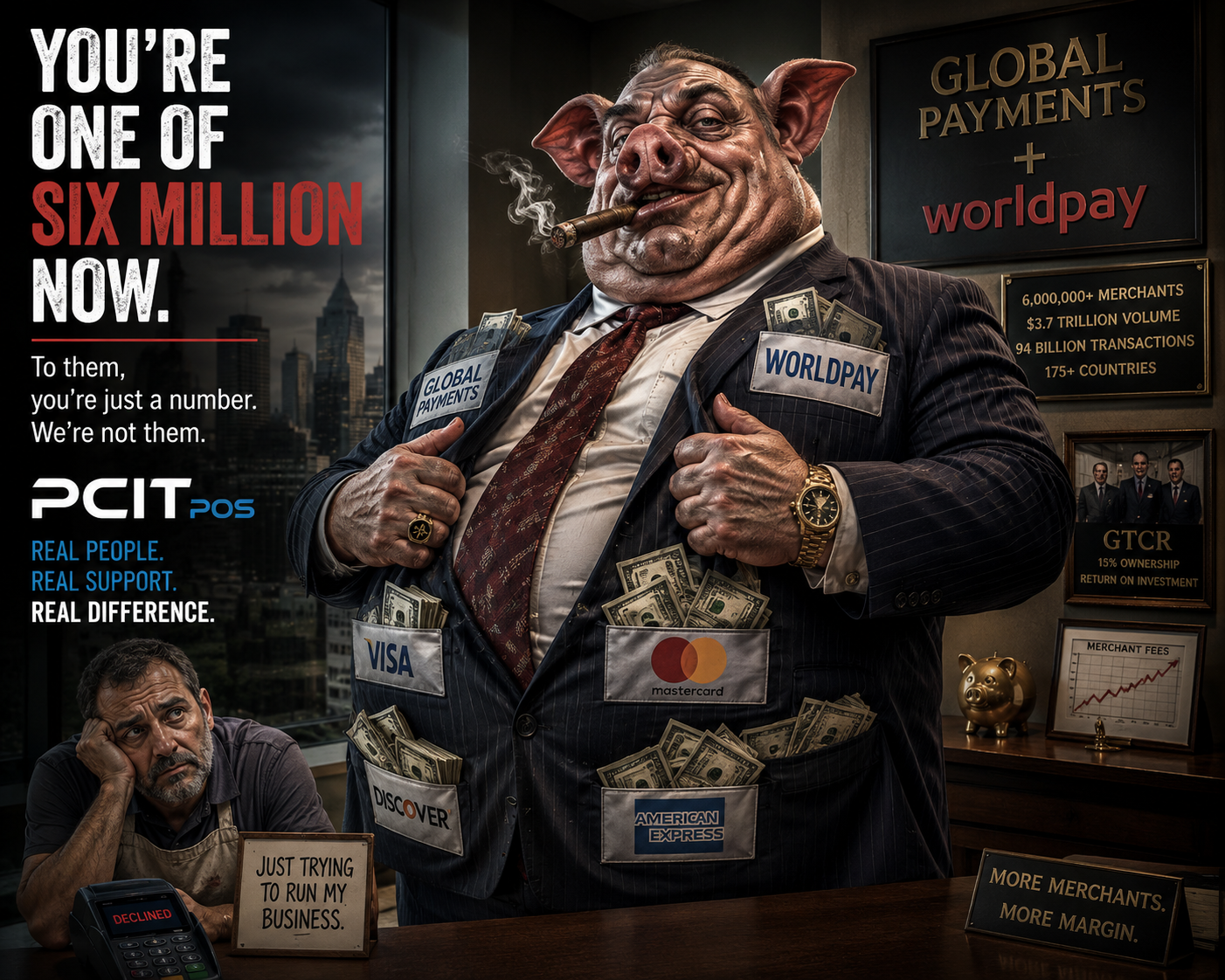
In January, Global Payments closed its acquisition of Worldpay. Global Payments completed its acquisition of Worldpay and divestiture of its Issuer Solutions business on January 9, 2026, creating a leading pure-play merchant solutions company. The price tag was $24.25 billion of cash and stock. And the combined company? The combined company will serve more than 6 million merchant locations, processing $3.7 trillion in payment volume and approximately 94 billion transactions annually across more than 175 countries. Global Payments + 2
Those are the numbers in the press release. Here is the one that matters to you: you are now one of six million.
Read that again. Six million merchant locations under one roof. Somewhere in that pile is a guy running a bodega on a side street, a family restaurant that does decent lunch numbers, a used car lot moving a dozen units a month. To a company processing 94 billion transactions a year, that merchant is not a customer. He is a data point. A rounding error with a terminal.
Now, the official line on these mega-mergers is always the same. More scale. More innovation. Better service for clients of every size. Nobody who has spent twenty-five years in this business believes a word of it, and here is why.
When two of the largest payment processors on the planet become one, the math does not work in the merchant’s favor. The people who pay for a 24 billion dollar deal are not the executives who signed it. The merchant pays. The bill shows up the way it always does, quietly, on your monthly statement, in line items with names engineered to be ignored. Payment consultants who audit merchant statements for a living will tell you consolidation at this scale almost never lowers prices. What tends to show up afterward are recovery charges, program fees, and vaguely named items that exist for one reason: to protect the processor’s margin while the rest of the market squeezes it.
And here is a detail most merchants never hear about. When the Worldpay deal closed, a private equity firm walked away owning a big piece of the combined company. GTCR will own shares representing approximately 15% of Global Payments’ equity capitalization. Think about what that means at the counter. The people who now have a financial stake in what you pay to swipe a card are a Chicago private equity shop. They have never stood behind your register. They have never watched a line back up because the terminal froze on a Friday night. They have a spreadsheet, a return target, and six million merchants to hit it with. PR Newswire
That is the part nobody puts in the press release. Your processing fee is no longer just the cost of moving money. It is also somebody’s return on investment.
So let’s talk about the thing that actually breaks when you become one of six million. Support.
Picture it. Your card reader goes down during the dinner rush. You call the number on the back of your statement. You get a phone tree. You press one, you press four, you confirm a merchant ID you have to dig out of a drawer, you get put on hold, and eventually you reach somebody in a call center who has never seen your store, never met you, and has no authority to fix anything beyond reading a script. By the time it gets escalated to someone who can actually help, the rush is over and you’ve lost the sales. That is not a bug in the system. At six million locations, that is the system. It has to be. There is no other way to support that many merchants for the price they want to charge you.
This is where we do things differently, and it is the whole reason PCIT POS exists.
At PCIT, the network engineer who installs your point of sale system is the same person who manages it and the same person who picks up when something goes wrong. Not a call center. Not a ticket queue routed overseas. Not an escalation path with four layers between you and a fix. The person who set up your system knows your store, knows your setup, and knows your name. When you call, you are not account number 4,815,162. You are a business he installed, and he has a stake in keeping you running.
That is a different relationship than the one the merged giants are offering. They are selling scale. We are selling the opposite. We are selling the idea that the person responsible for your payments should be a person you can actually reach.
On fees, our position is just as simple. We tell you what you pay and why. No mystery recovery charges. No line items designed to be skipped over. If a fee is on your statement, we can explain it in plain English, because we are the ones who set up the account and we are the ones who answer for it. Transparency is not a marketing word for us. It is just what happens when the engineer and the support contact and the person reading your statement are all the same human being.
The payment industry is consolidating. That is not a prediction, it is the headline. The giants are getting bigger, the merchant is getting smaller, and somewhere in a quarterly earnings call your processing fee is being described as a growth opportunity.
You can be one of six million. Or you can work with a company in Central Florida where the engineer who built your system answers the phone.
We know which one keeps you running on a Friday night.
PCIT POS
www.pcitpos.com
714-574-8980


